
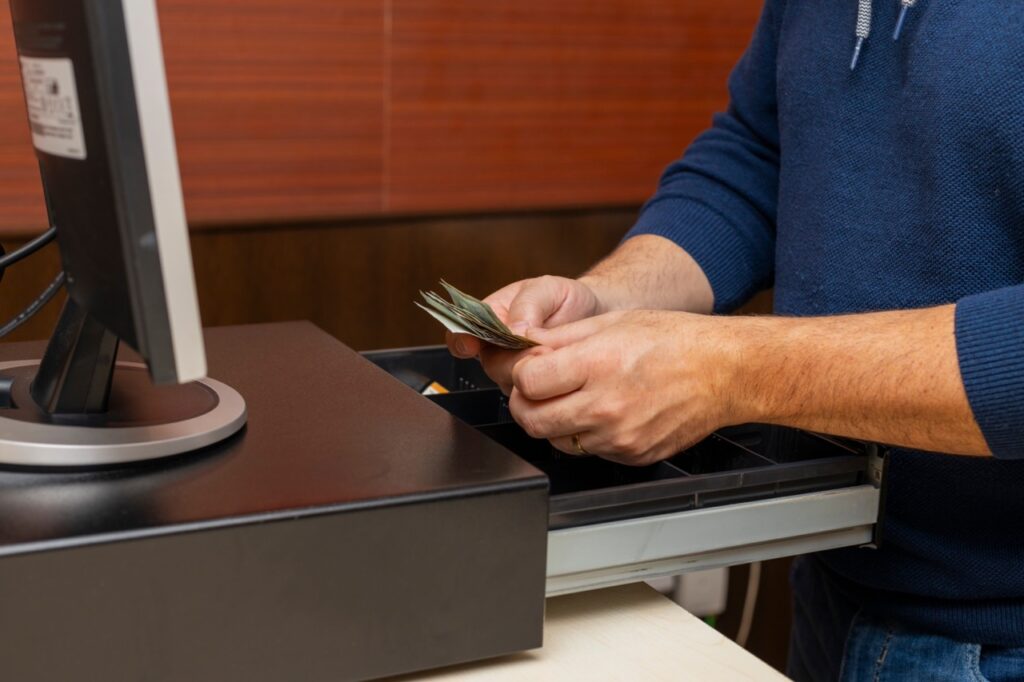
Cash handling is one of the most operationally intensive and error-prone functions in an independent grocery store. Every shift change requires a drawer count. Every end of day requires a reconciliation. Every variance between the expected total and the actual count requires investigation. And every error, whether from making change incorrectly, miscounting a drawer, or a discrepancy that takes thirty minutes to track down, costs time that managers should be spending on higher-value activities.
For many independent grocers, cash handling inefficiency is accepted as an unavoidable cost of doing business. The assumption is that cash is inherently messy and the administrative overhead is simply the price of accepting it. That assumption is worth examining, because a significant portion of cash handling errors and reconciliation time is not inherent to cash. It is the result of a POS system that does not give cashiers and managers the tools to handle cash efficiently and accurately.
Here is how the right POS tools reduce cash errors and reconciliation time without eliminating cash acceptance or adding complexity to your team’s workflow.
Understand Where Cash Errors Actually Come From
Before addressing cash handling errors, it helps to understand their most common sources. In a grocery store environment, cash errors typically originate from a small number of repeatable causes:
- Change-making errors: a cashier gives incorrect change, either due to mental arithmetic mistakes or distraction during a busy period
- Drawer count errors: a cashier miscounts their drawer at the beginning or end of a shift, creating a variance that does not reflect an actual cash discrepancy
- Unrecorded transactions: a transaction that is processed outside the POS, such as a manual sale during a system issue, that is not properly reconciled against the cash collected
- Till management errors: cash removed from the drawer for a drop or added for change without being properly recorded in the system
- Internal theft: small amounts removed from the drawer deliberately over time, typically in amounts small enough to be within the noise of normal counting variance
Each of these has a different solution, and a POS system that addresses all of them reduces your total cash error rate more effectively than any single intervention.
Use Exact Change Prompts to Eliminate Change-Making Errors
The most common source of cashier cash errors is making change incorrectly, and it is one of the easiest to eliminate with the right POS configuration. A POS that displays the exact change amount due to the customer when cash is tendered removes the mental arithmetic from the cashier’s responsibility entirely.
When a cashier enters the amount of cash tendered and the system displays both the change due and the suggested denomination breakdown, the cashier’s job becomes mechanical confirmation rather than calculation. This is particularly valuable during busy periods when cognitive load is high and the temptation to shortcut mental arithmetic is strongest.
FlexRetail’s POS interface includes cash tendering workflows designed to support accurate change-making without requiring cashiers to calculate independently. The result is fewer change errors, fewer customer disputes at the register, and less time spent investigating discrepancies after the fact.
Implement Blind Drawer Counts to Improve Count Accuracy
A blind drawer count is a count performed without prior knowledge of what the system expects the drawer to contain. The cashier counts the actual cash in the drawer, records the total, and then the system compares that total to the expected amount based on the opening balance and the transactions recorded during the shift.
The alternative, a non-blind count where the cashier knows the expected total before counting, creates a psychological bias toward confirming the expected number rather than counting objectively. Small errors get rationalized rather than flagged, and the reconciliation record becomes less reliable as a result.
Implementing blind drawer counts as a standard procedure requires your POS system to support a workflow where the expected total is hidden during the count and revealed only after the cashier has submitted their count. This is a configuration choice that significantly improves count accuracy and creates a more reliable audit trail without adding meaningful time to the counting process.
FlexRetail’s back-office management tools support blind count workflows as part of the standard cash management configuration, making it practical to implement this best practice without requiring a separate cash management system.
Record Every Cash Movement in the System
One of the most common sources of unexplained cash variances is cash movements that happen outside the POS: a manager removes cash for a bank deposit without recording it, a cashier opens their drawer to provide change to another lane without a transaction, or a till loan is added to a drawer without being documented.
Every cash movement in and out of a register drawer should be recorded in the POS system at the time it occurs, with the amount, the reason, and the identity of the person performing the action. This creates a complete audit trail that makes end-of-day reconciliation straightforward: the system knows every transaction that affected the drawer balance, and the closing count should match the expected total within the normal tolerance of counting variance.
When the audit trail is incomplete because some movements were not recorded, reconciliation becomes an investigation rather than a confirmation, and the time required grows proportionally with the number of unrecorded movements.
FlexRetail’s cash management tools require documentation of all drawer movements, including paid-outs, paid-ins, and safe drops, so the reconciliation record is complete by the time the end-of-day count begins.
Automate the Reconciliation Comparison
End-of-day reconciliation should be a comparison, not a calculation. When your POS system automatically generates the expected cash total based on the opening balance, recorded transactions, and documented cash movements, the reconciliation process becomes: count the drawer, enter the count, review the variance. The system does the arithmetic.
In stores where this calculation is done manually, with a manager adding up transaction totals from a report and comparing them to a hand-counted drawer, the process takes significantly longer and introduces additional opportunities for error in the reconciliation calculation itself.
The time savings from automated reconciliation comparison compound significantly across a week of operations. A reconciliation that takes twenty minutes when done manually and five minutes when automated by the POS system saves fifteen minutes per shift change, which adds up to meaningful manager time returned to higher-value activities over the course of a week.
Use Variance Tracking to Identify Patterns Over Time
A single cash variance on a single shift might be a counting error, a change-making mistake, or simply the normal noise of high-volume cash handling. A pattern of variances concentrated in specific shifts, specific cashiers, or specific times of day is information worth acting on.
Your POS system should track variance history in a format that makes these patterns visible over time rather than treating each variance as an isolated event. When you can see that a specific cashier consistently has small negative variances, that a specific shift consistently produces larger-than-average discrepancies, or that your variance rate increases during your busiest hours, you have actionable information for training, scheduling, and operational adjustments.
FlexRetail’s reporting tools capture variance history at the cashier and shift level, making the pattern analysis that transforms individual variances from mysteries into manageable operational data a standard part of your back-office reporting rather than a special investigation.
Set Variance Thresholds and Review Consistently
Not every cash variance warrants a full investigation, and setting clear thresholds for when a variance triggers a review versus when it is within acceptable tolerance helps managers use their time efficiently. A two-dollar variance on a shift that processed three hundred cash transactions is statistically unremarkable. A forty-dollar variance on the same shift is not.
Documenting your variance threshold policy and reviewing against it consistently creates accountability without creating overhead for minor discrepancies that are genuinely within the normal range of cash handling accuracy. When the threshold is exceeded, the review process should be documented and the outcome recorded so the history of significant variances is available for pattern analysis.
Schedule a FlexRetail demo to walk through the cash management and reconciliation tools available in the platform and see how the workflow is configured for a store your size and transaction volume.